

What Is a Big Box? Definition, Types, Uses & Why It Matters for Industrial Packaging
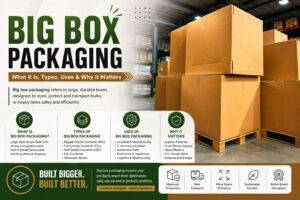
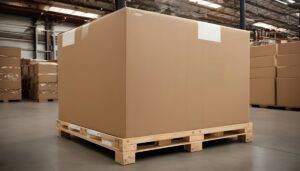
A Big Box is a heavy-duty industrial packaging solution designed specifically for products that are too large, too heavy, or too valuable for standard packaging formats. It handles loads from 100 kg to over 2,000 kg. Furthermore, it uses multi-material construction — combining plywood panels, steel fittings, honeycomb inserts, and protective liners — to protect critical components throughout complex supply chains.
What Is a Big Box?
A Big Box is a custom-engineered, large-format packaging unit that a manufacturer builds around a specific product — not the other way around. It differs fundamentally from standard packaging because engineers design every dimension, material, and fitment from scratch based on the actual product’s weight, geometry, fragility, and transit journey.
Big Box vs Standard Industrial Box — The Core Difference
A standard industrial box comes in fixed sizes from a catalogue. You select the nearest available size and fill the gap with void-fill material. On the other hand, a custom-engineered packaging solution matches the product exactly. Moreover, it undergoes prototype testing before production — something standard packaging suppliers may not offer. As a result, every box Ficus Pax produces is designed to arrive at the destination in the same protected condition as it left the factory.
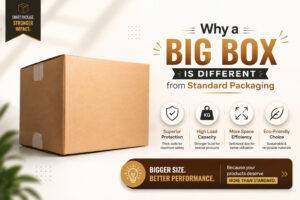
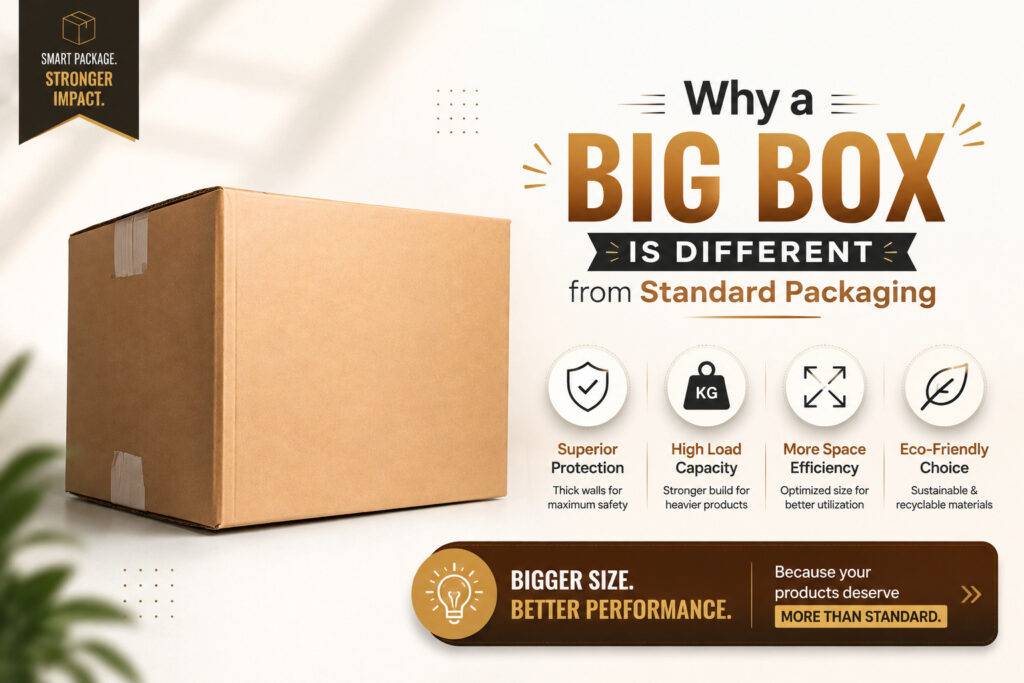
Why a Big Box Is Different from Standard Packaging
Standard packaging protects products from minor handling impacts. A heavy-duty industrial packaging unit protects products from compressive loads, vibration during sea freight, temperature changes across climate zones, and rough multi-modal handling — simultaneously. Therefore, this type of packaging requires structural engineering expertise, not just manufacturing capability.
Engineering vs Selection — What Changes Everything
Standard packaging suppliers select a box from a range. Box specialists engineer a solution around the product. Ficus Pax employs 30 packaging engineers — most from the Indian Institute of Packaging — who design every custom packaging solution from the ground up. Consequently, clients receive packaging that performs under the exact conditions their product faces, rather than packaging that merely looks adequate on paper.
When Does Your Business Need a Big Box?
Businesses typically recognise the need for heavy-duty packaging after experiencing packaging failures. However, identifying the signals early saves significant cost and prevents supply chain disruption.
Signals That Standard Packaging Is Failing You
- Your product weighs over 100 kg and standard boxes deform or split during transit.
- Your component has non-standard dimensions — L-shaped, circular, tapered, or exceeding 100 cm in any direction.
- Your OEM or export customer specifies a packaging standard your current supplier cannot meet.
- You stack units four or five high in shipping containers and base compression causes structural failure.
- Transit damage rates stay unacceptably high despite improving handling procedures.
- Your export destination requires ISPM 15 compliant wood packaging and certified documentation.
Notably, each of these situations calls for a custom-engineered packaging unit — not simply a larger version of what you currently use.
Types of Big Box Available in India
Ficus Pax manufactures large-format packaging solutions across several construction types. The right choice depends on the product weight, geometry, handling method, and transit conditions.
What Goes Inside a Big Box — Materials and Protection
The structural performance of a heavy-duty packaging unit depends entirely on how engineers select and combine materials. Moreover, each material serves a specific protection function — not a generic filler role.
Industries That Rely on Big Box Packaging in India
Every major industrial sector in India uses large industrial packaging for critical component shipments. Furthermore, global OEMs operating in India specify packaging requirements that their supply chain partners must meet.
Aerospace, Automotive, Heavy Engineering and More
Aerospace and Defence — aircraft fuselage panels, tail cone assemblies, engine components, radar systems. Ficus Pax supplies Boeing-certified tier suppliers, Tata Aerospace, RUAG, and Cobham Defence.
Automotive — engine blocks, gearbox assemblies, body panels, sub-assemblies for Volkswagen, General Motors, and Tata Motors supply chains.
Heavy Engineering — compressors, pumps, hydraulic systems, power generation components requiring extreme load ratings and forklift-integrated bases.
Electronics and Electricals — transformer cores, industrial switchgear, UPS systems requiring anti-static protection combined with structural load capacity.
Export and International Logistics — any industrial component moving internationally in a large-format packaging unit must survive extended multi-modal transit and customs inspection.
How to Choose the Right Big Box for Your Product
Choosing the right industrial packaging solution starts with understanding what the product needs — not what the manufacturer stocks. Moreover, several factors directly determine which construction, material set, and load rating your product requires.
What to Evaluate Before You Order
Product weight and dimensions — exact measurements, not approximations. Centre of gravity matters for base design.
Transit route — road, sea, air, or multi-modal. Each mode creates different mechanical stresses on the packaging.
Stacking requirements — how many units stack in a container? The base must carry the cumulative load without deforming.
Environmental exposure — humidity, temperature variation, and dust levels along the transit route determine liner and barrier requirements.
Why Ficus Pax Engineers Every Big Box From Scratch
Ficus Pax has engineered custom packaging solutions for India’s most demanding industries for over 25 years. Our clients include Rolls-Royce, General Electric, Tata Aerospace, Volkswagen, General Motors, Siemens, JCB, and Schneider Electric. These organisations choose Ficus Pax because their products demand engineering — not catalogue selection.
FAQ
Q: What is a Big Box in industrial packaging?
A Big Box is a custom-engineered, heavy-duty packaging solution for industrial products that exceed the capacity of standard packaging.
Q: How does a Big Box differ from a standard industrial packaging box?
A standard industrial box comes in fixed catalogue sizes — you select the nearest fit. A custom-engineered box matches the product exactly and uses multi-material construction to provide greater structural protection.
Q: What materials does a Big Box use?
Ficus Pax large-format packaging units use a combination of E-1 grade plywood panels, pinewood framing, steel corner fittings, and honeycomb board inserts.
Q: What industries use Big Box packaging in India?
Aerospace, automotive, heavy engineering, electronics, defence, and export logistics industries use heavy-duty industrial packaging in India.
Q: Does a Big Box need ISPM 15 certification for export?
Yes. Any wood-based industrial packaging containing plywood panels, timber frames, or wooden bases needs to comply with applicable ISPM 15 requirements for international export.
📞 +91 6366961615
🌐 ficuspax.com
📧 info@ficuspax.com
📍 Bangalore