

Anti-shock and vibration protection
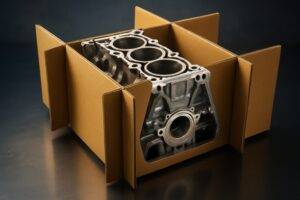
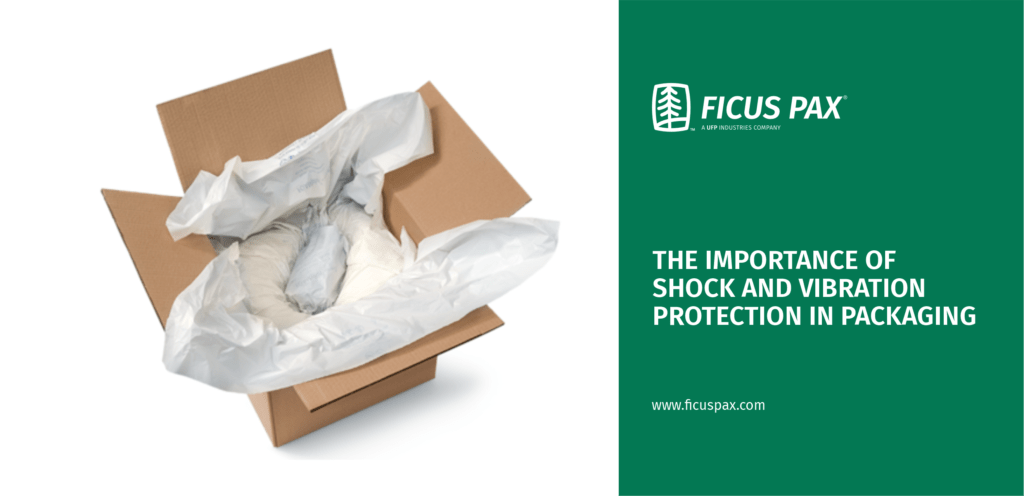
Anti-shock and vibration protection. Sensitive products require anti-shock and vibration protection. Ficus Pax offers industrial packaging solutions such as shock-absorbing material that reduces vibrations and shocks, as well as bracing that separates and holds products in place.
What effect does vibration have on packaging?
Every mode of transportation vibrates packages. Therefore, engineers must analyze vibration frequencies to prevent damage.To protect vibration-sensitive products, Engineers determine the natural frequency of components vulnerable to vibration damage, of any component that is susceptible to vibration damage and compare it to the vibration characteristics of the packaging design.
How to Choose the Best Vibration Protection
To prevent vibration damage during shipment, design the packaging so it does not amplify vibration (increase) vibration at the product’s natural frequency. Anti-shock and vibration protection
Package Design Manual
The first step in cushioning design is identifying how much mechanical shock a product can withstand how much mechanical shock a product can withstand. There are several terms for this, the most common of which are “fragility” and “g-factor.”
Typical Packaged Articles’ Approximate Fragility
Engineers determine product fragility by applying increasingly severe shocks. to increasingly severe shocks. Anti-shock and vibration protection and it is not uncommon for a product to exhibit greater strength in one direction than another
Packaging Drops and Shock Forces
Shock occurs when a pack experiences a sudden change in velocity. An example of this is a truckload falling off the back onto the sidewalk.
- Unitized loads experience fewer drops than single packs.
- Packs are frequently dropped from lower heights, but the likelihood of a pack being dropped from three feet more than once is low.
- Because light packs are likely to be carried in a variety of orientations, their behavior when dropped is unpredictable.
- Heavier packs have a 50% chance of landing on their base.
- Handholds reduce the likelihood of a high drop height by making it easier to lower the pack to the ground.
Calculating the fragility factor of a product
One of the most common methods for determining a product’s fragility is to take repeated drop samples and measure the drop height at which damage begins to occur. However, quantifying fragility as a drop height is only useful if the pack contains no additional cushioning protection.
Cushioning
Dynamic cushioning curves, which are available for most cushioning materials, can be used to estimate cushioning thickness. The minimum and maximum static loads are represented by the two points where the critical acceleration line crosses. Typically, a static load near the minimum point of the curve is chosen, but designing with higher static loads reduces cushion material area.
Cushioning Against Shock
Any material that deflects under a load can be used as a cushioning material. Cushioning materials reduce the peak G level by deforming under impact. experienced by the product when compared to the shock pulse felt at the package surface by deforming. Polymeric materials are available in various densities. For example, EPS, polyurethane foam, and air bubble sheets provide effective cushioning.
Polymeric materials include expanded polystyrene (EPS), foam polyurethane, and air bubble sheet. These materials may be more suitable in terms of cleanliness.
Pre Shipment Testing Equipment
Vibration Tables
Vibration tables evaluate how products and packages respond to vibration. They are classified into two types: Repetitive-shock vibration tables have an acceleration of 1.1 G, an amplitude of 1 inch, and a frequency of 4.5 hertz.
The ASTM specifies the following vibration tests:
- D-4782, Random Vibration Testing of Shipping Containers
- D 5112, Vibration (Horizontal Linear Sinusoidal Motion) Test of Unpacked Products and Components
- D 999, Vibration Testing of Shipping Containers
- D 1185, Pallets and Related Structures Used in Materials Handling and Shipping
Horizontal and Inclined (Conbur) Impact Machines
The incline impact machine mimics horizontal shocks experienced during rail shipments.
ISTA and ASTM pre-shipment test methods specify incline impact tests, which are described below:
- ASTM D 1185, Pallets and Related Structures
- ASTM D 880, Incline Impact Test for Shipping Containers
- ASTM D-4169, Performance Testing of Shipping Containers and Systems, is used in handling and shipping.
- Horizontal impact machines are a newer, more controllable way to generate horizontal shocks.
- The load is accelerated along a horizontal track and into a programmable backstop by these machines.
Compression Test Systems
Warehouse stacking ability is directly related to compression strength. A compression test system is used to determine a package’s load-carrying capabilities. Units range in size from small enough to measure the compression strength of plastic bottles to large enough to measure the stacking strength of entire pallet loads.
ASTM D 4332 specifies recommended standard atmospheric conditions.
Shock Devices
Shock machines are used to create fragility boundary curves and G levels for calculating cushioning requirements or assessing the design fragility of a product.
The following are descriptions of shock machine tests:
- Mechanical Shock Fragility of Products Using Shock Machines, ASTM D 3332
- Transmitted Shock Characteristics of Foam-in-Place Cushioning Materials, ASTM D 4168
- Standard Practice for Simulated Drop Tests of Loaded Containers Using Shock Machines, ASTM D 5487
Summary of ASTM D 4169 distribution testing elements
To use the procedure, first determine the nature of the distribution environment you want to simulate in the laboratory, as well as the shipping unit for each stage of the journey.
Other Test Methods and Standard Practices
The following are selected other standards related to packaging materials:
- ASTM D 6198, Standard Guide for Transport Package Design
- ASTM D 4649, Selection of Stretch, Shrink, and Net Wrap Materials
- ASTM D 5118, Fabrication of Fiberboard Shipping Boxes
- ASTM D 5168, Fabrication and Closure of Triple-Wall Corrugated Fibrous Containers
The appropriate type of protection is determined by what you are shipping, how it will be shipped, and several other factors. We have various types of protections at Ficus Pax that can be used for a wide variety of different types of goods. To learn more about our services.
📞 Contact us today to learn how we can protect your products with precision-engineered packaging solutions. contact us.